

How often should you weigh yourself? Research and clinicians do not give one answer for everyone. Some people do best stepping on the scale every morning, others once or twice a week. What matters more is weighing the same way each time and reading the trend instead of reacting to a single morning.
The Short Answer
There are two reasonable rhythms, and both have support:
- Daily weigh-ins. Several studies of people in weight loss and weight maintenance programs link weighing every day with more weight lost or less weight regained. Daily numbers swing, so they are most useful read as a trend over time rather than one morning at a time.
- Once or twice a week. Cleveland Clinic registered dietitian Maxine Smith, RD, LD, says weighing once a week is fine if you weigh on the same or a similar day each week, and Cleveland Clinic endocrinologist Peminda Cabandugama, MD, suggests once or twice a week for people who find daily swings discouraging.
Whichever you pick, Cleveland Clinic's advice is consistent: same scale, same time of day, same clothing (or none), on a hard, flat floor.
What the Research Says About Weighing Every Day
A 2015 systematic review in the journal Obesity looked at 17 prospective studies of adults seeking weight loss treatment. Regular self-weighing was associated with more weight loss, and in those studies it was not associated with depression or anxiety. The review also noted that how often people weighed, and how strong the effect was, varied from study to study.
A 2015 analysis in the Journal of the Academy of Nutrition and Dietetics followed 47 adults in a six-month program built around daily weighing on a connected scale. About half weighed every day. The rest weighed most days, about five days a week on average. The daily weighers lost about 13 pounds more on average and reported adopting more weight control behaviors than the people who weighed most days. It was a small group, so treat it as a useful signal rather than a rule.
Weighing also shows up in weight maintenance research. A 2006 trial in the New England Journal of Medicine followed 314 adults who had lost an average of about 42 pounds in the previous two years. The program emphasized daily self-weighing and self-regulation, and over 18 months daily weighing was associated with a lower risk of regaining about 5 pounds or more.
In each of these studies the scale was part of a broader weight loss or maintenance program, not a stand-alone fix.
Is It Bad to Weigh Yourself Every Day?
For many people, no. For some, it can be. Cleveland Clinic endocrinologist Peminda Cabandugama, MD, advises against weighing every day because daily weight tends to fluctuate and the habit can become unhealthy for some people. He suggests once or twice a week instead.
The research on mood is mixed too. A 2015 review in Current Obesity Reports found that daily weighing may have downsides for some people, especially women and younger adults, even though many studies of people in weight loss programs found no harm.
Cleveland Clinic dietitian Maxine Smith adds that if you have a history of eating disorders, or stepping on the scale makes you anxious, it can help to avoid the numbers and talk with a behavioral health specialist. She also recommends setting small behavior goals you can measure, rather than judging yourself by a single number.
Smith's broader point is to find the routine that works for you and make sure it is not getting in the way of progress. If daily numbers help you notice patterns and stay calm, daily can work. If a higher morning reading ruins your day, a once-a-week check on the same weekday may suit you better.
Daily, Weekly, or Twice a Week: Picking a Rhythm
- Every morning. Weigh at the same time under the same conditions, write it down or let an app log it, and watch the direction over weeks rather than the daily number. Cleveland Clinic psychologist Leslie Heinberg, PhD, notes that writing weight down helps people follow trends over time and catch a steady upward drift early.
- Once a week. Pick one weekday and keep it. Smith points out that many people eat and drink differently on weekends, so a Monday reading and a Friday reading can look very different. She says some people like Friday because it reflects a consistent workweek routine.
- Twice a week. A middle option that Dr. Cabandugama suggests. Smith's same-day logic applies here too: keep both days fixed so each reading compares with the last one taken on that weekday.
Why Does My Weight Go Up and Down So Much?
Day-to-day swings are normal. Cleveland Clinic says daily fluctuations of a few pounds are common and puts the typical window at about 5 to 6 pounds a day, or 2 to 3 pounds in either direction, even for people in a healthy weight range. Common reasons Cleveland Clinic lists:
- Water retention. This is the most common cause of short-term changes. A meal high in sodium or carbohydrates can make your body hold more water for a while.
- Food and drink still being digested. Everything you eat or drink adds a little weight until it passes through.
- Exercise. Strength training can add muscle, which also weighs something.
- Hormonal changes. Menstrual cycles, pregnancy, and menopause can shift water and weight.
- Stress, sleep changes, and travel. These can change eating habits, activity, and water retention.
- Alcohol and constipation. Both can add to a sudden overnight jump.
- Some medications. Cleveland Clinic names antidepressants, insulin, and beta-blockers as examples that can affect weight.
There is also a weekly pattern. A 2014 study in Obesity Facts analyzed more than 4,600 daily weigh-ins from 80 adults and found weight tended to be highest on Sunday and Monday and to drift down through the week. The authors concluded that weekend-to-weekday variation should be treated as normal rather than as a sign of weight gain.
What Is the Best Time to Weigh Yourself?
Cleveland Clinic's Maxine Smith says the best time is first thing in the morning, after using the bathroom and before you eat or drink. By then your body has had the night to digest the previous day's meals. Her steps for a consistent weigh-in:
- Weigh first thing in the morning.
- Wear little to no clothing, or the same outfit every time.
- Set the scale flat on a hard floor. A tilted scale or carpet can throw off the reading.
- Stand tall and still, barefoot, with your weight evenly spread over both feet.
If you weigh daily, Smith adds, use the same scale every time.
How to Read the Number Without Overreacting
A single reading is one data point. Before you change anything, ask a few questions:
- Did you weigh under the same conditions as last time (same time, same clothing, same scale)?
- Was yesterday unusual: a salty restaurant meal, alcohol, a long flight, a hard leg day, poor sleep, or a point in your cycle when you usually retain water?
- Is the change still there when you compare this week's average, or this weekday, with the same reading a week or two ago?
Dr. Heinberg notes that if your weight is consistently up over days or weeks, that is the signal worth acting on, and it is easier to course-correct early. Cleveland Clinic also advises talking with a healthcare provider if your weight changes a lot suddenly without a clear reason, or if you are retaining water for no obvious reason.
When the Scale Does Not Show Everything
Body weight is the sum of fat, muscle, water, and everything else. Smith points out that if you start exercising more, your weight might go up because you are gaining muscle, and that salt, carbohydrates, and some medications change how much fluid you carry. Dr. Cabandugama adds that what usually matters for health is a loss of fat mass, and he suggests other progress checks such as photos in the same clothes every two weeks, a tape measure for waist and hips, and how you feel day to day.
That is where a body composition scale can add context. Instead of weight alone, it estimates how much of that weight is fat, muscle, and water, so a flat week on the scale is easier to make sense of.
Where the Hume Health Body Pod Fits
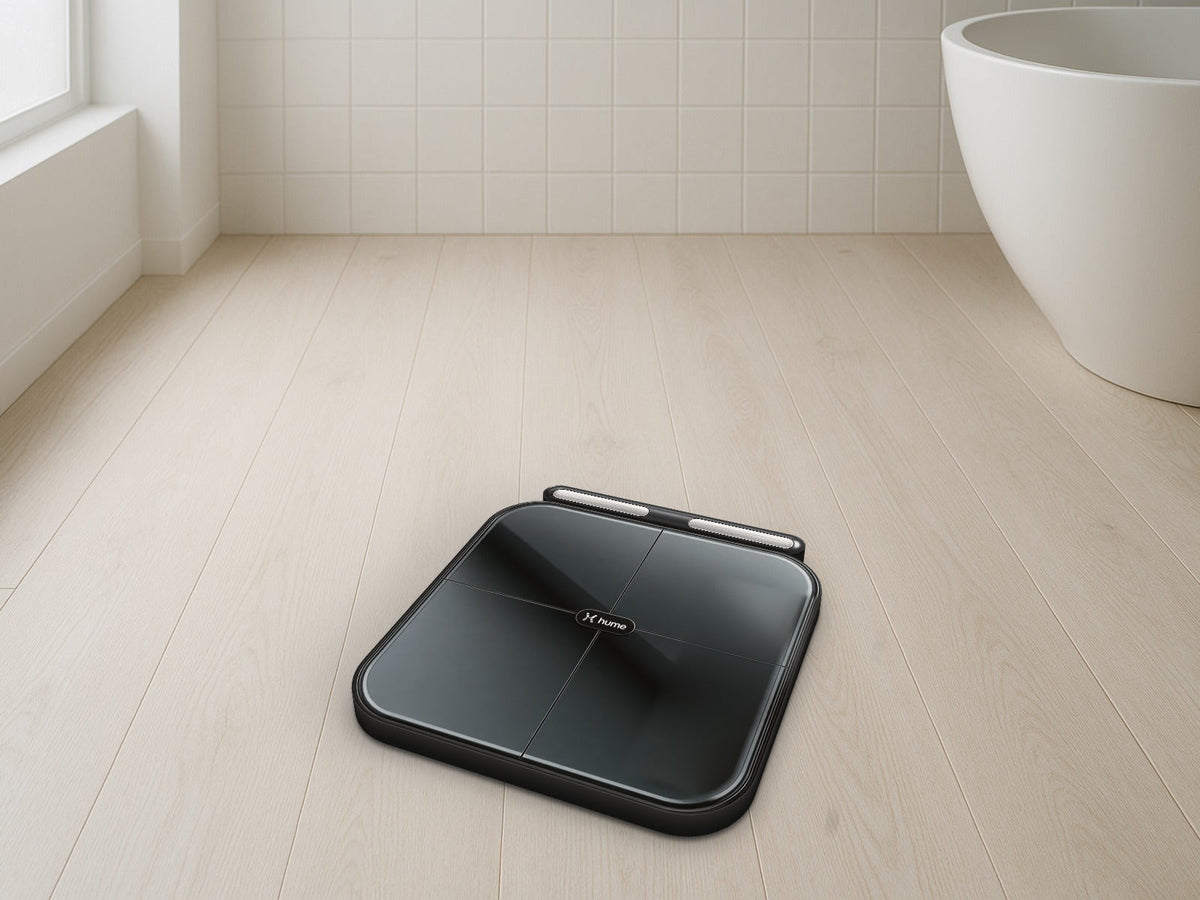
We carry the Hume Health Body Pod, a body composition scale with a handheld bar. Hume says it uses bioelectrical impedance analysis through the platform and the handles to estimate body fat, muscle mass, and body water along with weight. The free Hume Health app shows weekly, monthly, and yearly averages for weight and other metrics, so daily weigh-ins can be read as a trend instead of one morning at a time. Each person in a household can use their own Hume account so trends stay separate.
Like any home body composition scale, its readings are estimates for personal trends, not a clinical scan. Hydration, meals, and exercise can move them, so the same weigh-in routine above applies. For more detail:
- What Does the Hume Body Pod Measure? At-Home Metric Guide
- Is the Hume Body Pod Accurate? App Subscription FAQ
- How to Set Up the Hume Body Pod: Pairing, First Weigh-In, and Quick Fixes
- What Is the Best At-Home Body Composition Scale? Hume Health Body Pod
Browse more tools in Smart Health & Fitness Devices and Wellness.
FAQ
How often should you weigh yourself to lose weight?
Studies of people in weight loss programs link regular weighing, often daily, with more weight lost, as long as it sits alongside changes to eating and activity. Weekly weighing on the same day is also a reasonable choice, especially if daily numbers make you anxious. Pick the rhythm you can keep consistently.
Is weighing once a week enough?
For many people, yes. Cleveland Clinic's Maxine Smith says once a week is fine as long as you weigh on the same or a similar day each week, at the same time and in the same clothing. The tradeoff is that a single weekly reading can land on a day when you are holding extra water, so look at several weeks before drawing conclusions.
Why do I weigh more at night than in the morning?
By evening you are carrying the food and drink from the day that has not been digested yet, plus any water your body is holding from salty or carbohydrate-heavy meals. Cleveland Clinic recommends weighing first thing in the morning, after the bathroom and before eating or drinking, for a steadier number.
Why did I gain weight overnight?
Often it is water. Cleveland Clinic says sudden overnight gain with bloating is often water retention from high-sodium foods, alcohol, travel, or the menstrual cycle, and constipation can add to it. If the change does not settle back within your usual range, or you are retaining water for no obvious reason, check in with a healthcare provider.
Should I weigh myself after a workout?
Not for tracking body weight, because a post-workout reading mostly reflects sweat loss. A before-and-after weigh-in does have a different use: the American College of Sports Medicine's 2007 guidance on exercise and fluid replacement notes that sweat rate can be estimated from body weight before and after exercise. See How Much Water Should You Drink During a Workout? Sweat Rate and Electrolytes for that method.
Find more wellness and fitness guides in the Learning Center.
Disclaimer
Pure Supply Shop shares this guide as general wellness information. It is not medical advice. It does not diagnose, treat, cure, or prevent any disease. Home body composition scales, including the Hume Health Body Pod, give estimates for personal trend tracking and are not medical devices for diagnosis. Talk with a qualified healthcare professional about sudden or unexplained weight changes, swelling, or a history of disordered eating, and before using a body composition scale if you are pregnant, have an implanted medical device such as a pacemaker, or have a medical condition.


