

You mix your pre-workout, and a little later your face, ears, or the backs of your hands start to prickle. In most formulas, that feeling comes from one ingredient: beta-alanine. It is a common pre-workout ingredient with a well-studied job in muscle, and the tingle is a known, temporary side effect.
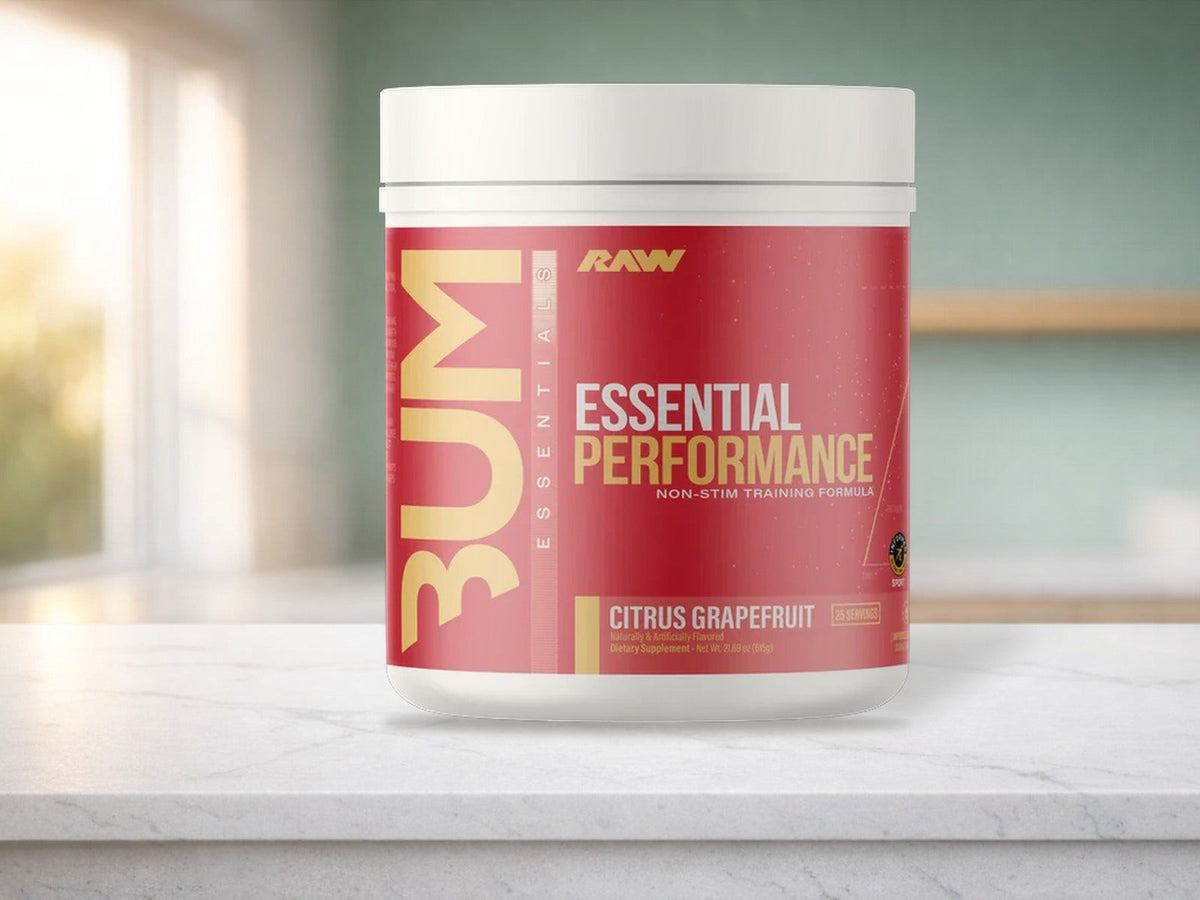
Want to shop first? See RAW Essential Performance Pre-Workout in Citrus Grapefruit or Blue Rathberry, a caffeine-free formula that lists beta-alanine on its label.
The Short Answer
- Beta-alanine is an amino acid your body uses to make carnosine, a compound stored in muscle that helps buffer the acid that builds up during hard efforts.
- The tingle is a known, temporary side effect called paresthesia. The NIH Office of Dietary Supplements says it is not considered serious or harmful.
- Beta-alanine works by building up in muscle over weeks of daily intake, not in the minutes after one scoop.
- Research shows the clearest benefit for hard efforts lasting about one to four minutes.
What Is Beta-Alanine?
Beta-alanine is an amino acid that your liver makes on its own, and you also get it from foods such as meat, poultry, and fish. The NIH Office of Dietary Supplements estimates that people get up to about 1 gram a day from food, depending on their diet.
Unlike most amino acids, beta-alanine is not used to build protein. Its main job is to team up with another amino acid, histidine, to form carnosine. According to the International Society of Sports Nutrition (ISSN), beta-alanine is the limiting ingredient for carnosine, which means the amount of beta-alanine available sets how much carnosine your muscles can make.
What Does Beta-Alanine Do in Your Muscles?
When you work hard for a minute or more, such as a set of high-rep squats, a hard sprint up a hill, or a fast row, your muscles produce acid faster than they can clear it. The NIH Office of Dietary Supplements explains that this buildup reduces muscle force and adds to tiredness.
Carnosine acts as a buffer inside the muscle cell, soaking up some of that acid. The ISSN's 2015 review in the Journal of the International Society of Sports Nutrition reports that taking beta-alanine raises muscle carnosine:
- About 20 to 30 percent after at least two weeks of daily use.
- About 40 to 60 percent after four weeks.
- Up to about 80 percent after 10 weeks in one study the review cites.
The review also notes that people respond differently. Some raise their carnosine much more than others, and once you stop, levels drift back to where they started over roughly 6 to 15 weeks.
Why Does Beta-Alanine Make You Tingle?
The tingle has nothing to do with carnosine. The ISSN review explains that beta-alanine appears to switch on sensory nerve receptors that end in the skin, and that is what you feel as prickling or pins and needles.
What the research says about the feeling:
- Where you feel it. The NIH Office of Dietary Supplements lists the face, neck, backs of the hands, and upper trunk.
- When it starts. The ODS says doses of 800 milligrams or more can cause it.
- How long it lasts. Both the ODS and the ISSN review say it usually fades within 60 to 90 minutes.
- Who gets it. Not everyone does. The ISSN review says the feeling is usually stronger with larger doses, and that there is no known reason some people are more sensitive than others.
Because the tingle comes from skin nerves and the performance effect comes from carnosine building up in muscle over weeks, a strong tingle is not a sign that a scoop is working better, and no tingle does not mean it is doing nothing.
Is the Pre-Workout Tingle Safe?
For healthy adults, the research so far is reassuring:
- The ISSN review found no evidence that the tingling is harmful, and it called beta-alanine safe in healthy people at the doses it recommends.
- A 2019 systematic review in Advances in Nutrition pooled 101 human studies. Tingling was the only side effect reported. In the highest-quality studies, about 19 percent of people taking beta-alanine reported it, compared with about 6 percent of people taking a placebo. People taking beta-alanine dropped out of studies at about the same rate as people taking a placebo.
There are limits to that evidence. The ISSN review notes that there is no safety data on use longer than a year, and the ODS says it is not known whether daily use for more than several months is safe. Most of the research is in healthy adults, so talk with a healthcare professional first if you are pregnant, nursing, under 18, or have a medical condition.
A rash, hives, or swelling is not the tingling these sources describe. Stop the product and talk with a healthcare professional if that happens. For a wider look at pre-workout ingredients and side effects, see Is Pre-Workout Powder Safe? Does It Work?
How to Reduce the Tingle From Pre-Workout
If the feeling bothers you, the ISSN review describes two ways studies have reduced it:
- Smaller, divided doses. Studies have lowered the tingle by splitting the daily amount into smaller doses of about 1.6 grams.
- Sustained-release beta-alanine. Slow-release forms caused much less tingling in the studies the review describes.
A pre-workout powder is a measured blend, so follow the directions on its label rather than splitting or changing servings on your own, and ask a healthcare professional or registered dietitian if you want to adjust how you take it.
Does Beta-Alanine Actually Work?
It can help, mostly for a specific kind of effort. The ISSN review concluded that daily beta-alanine for at least two to four weeks improved exercise performance, with the clearest effects in all-out efforts lasting about one to four minutes. It also found that beta-alanine reduced muscle fatigue in several studies, especially in older adults.
A 2017 systematic review and meta-analysis in the British Journal of Sports Medicine pooled 40 placebo-controlled studies with 1,461 participants. It found a small overall benefit. The effect was larger in tests where people kept going until they could not continue, lasting from 30 seconds to 10 minutes, than in timed races, and it was similar for trained and untrained people.
Where the evidence is less clear:
- Very short bursts. The ISSN review notes that efforts under about 60 seconds, such as a single sprint or a heavy set of a few reps, showed little benefit, because acid buildup is not what limits those efforts.
- Strength. Studies are mixed. Beta-alanine may help people do more total work in a session, but the ISSN review did not find that it adds to strength gains.
- Long endurance. The ISSN review says more research is needed for efforts longer than about 25 minutes.
How Much Beta-Alanine Do Studies Use?
The ISSN review recommends 4 to 6 grams a day, split into doses of 2 grams or less, for at least two weeks and preferably four, to raise muscle carnosine. It also notes that taking beta-alanine with a meal helped muscles load more carnosine in one study. The NIH Office of Dietary Supplements notes that most studies used 1.6 to 6.4 grams a day for 4 to 8 weeks.
For pre-workout blends, which usually contain beta-alanine with other ingredients, the ISSN review found that formulas with 2 to 4 grams of beta-alanine were safe in studies of single doses and of daily use for up to eight weeks. It added that any benefit from the beta-alanine in a blend depends on taking it long enough for carnosine to build up, at least four weeks.
Check how much beta-alanine is in every product you take, since pre-workouts, amino drinks, and other blends can each contain some. These amounts come from research settings, so follow your product label and talk with a healthcare professional before changing how much you take.
When to Take Beta-Alanine
Since beta-alanine works by building up over weeks, the exact time of day matters less than it does for caffeine. For how other common pre-workout ingredients fit around training, see When to Take Pre-Workout: Timing for Morning, Evening, and Non-Stim.
A Caffeine-Free Pre-Workout With Beta-Alanine
If you want a pre-workout without stimulants, RAW Essential Performance Pre-Workout comes in Citrus Grapefruit and Blue Rathberry. RAW describes it as having absolutely 0 stimulants, and the tub reads "Non-Stim Training Formula." Each serving lists:
- 3.2 grams of beta-alanine
- 6 grams of L-citrulline
- 5 grams of creatine monohydrate
- 2.5 grams of betaine anhydrous
- 2 grams of L-tyrosine
Each tub has 25 servings. Because it contains beta-alanine, you may feel the tingle described above. Check the supplement facts panel on the tub for the current formula and follow the label directions. To compare caffeine-free and caffeinated formulas, see Non-Stim vs Stim Pre-Workout: Pump Feel or Energy Kick?
FAQ
Why does pre-workout make my face itch or prickle?
In most formulas it is beta-alanine. The NIH Office of Dietary Supplements describes the feeling as tingling, prickling, or burning in the face, neck, backs of the hands, and upper trunk, lasting about 60 to 90 minutes.
Is the tingling from pre-workout bad for you?
The ISSN review found no evidence that it is harmful, and the ODS says it is not considered serious. A rash, hives, or swelling is different, so stop and talk with a healthcare professional if you notice those.
Does the tingle mean my pre-workout is working?
No. The tingle comes from nerve receptors in the skin, while beta-alanine's effect on performance depends on carnosine building up in muscle over several weeks.
Can you get used to the beta-alanine tingle?
The research reviewed here does not answer that directly. What it does show is that the feeling is stronger with larger single doses, and that smaller divided doses or sustained-release forms reduce it.
Does beta-alanine build muscle?
Not directly. The ISSN review found it may help you do more work in a session, but it did not find that it adds to strength gains. For why muscles look bigger right after training, see What Is a Muscle Pump? Why Your Muscles Look Bigger After a Workout.
Is beta-alanine a stimulant?
No. Beta-alanine is an amino acid, not a stimulant like caffeine, and the tingle is not a sign of caffeine. A pre-workout can still contain caffeine alongside it, so check the label.
Find more training guides in the Learning Center, or browse the Pre-Workout Powder collection.
Disclaimer
Dietary supplements are not drugs. These statements have not been evaluated by the Food and Drug Administration. Pre-workout powders are not intended to diagnose, treat, cure, or prevent any disease. Pure Supply Shop shares this guide as general fitness and sports nutrition information, and it is not medical advice. Talk with a qualified healthcare professional before starting a new supplement or training program, especially if you are pregnant, nursing, under 18, taking medication, or have a heart, blood pressure, kidney, or other medical condition. Follow the directions on the product label, and stop using any product that causes a reaction.


