

You finish a few hard sets of curls, look in the mirror, and your arms look bigger and feel tight. Lifters call it the pump. It is real, it is temporary, and researchers still debate what it means for long-term muscle growth. Here is what happens inside a working muscle, how long the effect lasts, what the research says about growth, and where a non-stim pump pre-workout fits.
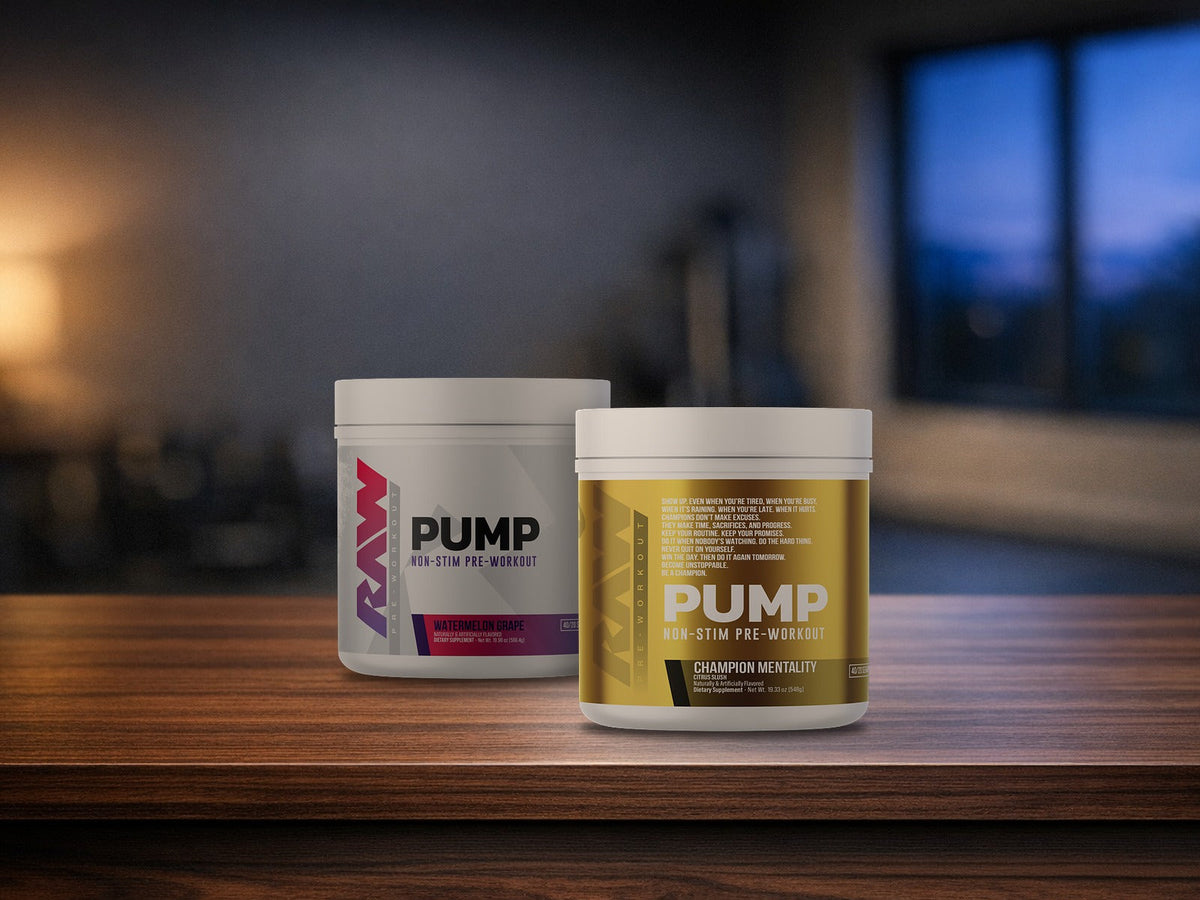
Want to shop first? See RAW Pump Non-Stim Pre-Workout in Champion Mentality or Watermelon Grape, or RAW Essential Performance Pre-Workout in Blue Rathberry or Citrus Grapefruit. Both are caffeine-free formulas.
The Short Answer
- A pump is a short-term swelling of a working muscle. Blood and fluid build up in the muscle faster than they drain away, so it looks fuller and feels tight.
- It fades after training. The pump itself is not new muscle.
- Researchers still debate whether chasing a bigger pump adds to long-term growth.
- Pump-style training, with moderate to higher reps and short rest, is one tool. Heavy, progressive lifting stays the foundation in the research described below.
What Is a Muscle Pump?
Sports scientists call it cellular swelling. Bodybuilders call it the pump. In a 2014 paper in the Strength and Conditioning Journal, exercise scientists Brad Schoenfeld and Bret Contreras describe it as muscles becoming engorged with blood during hard training, and note that lifters often enjoy the tight, full feeling enough to plan whole workouts around it.
The same paper notes that bodybuilders do high-repetition sets right before stepping on stage so their muscles look full and dense.
Why Do Muscles Get Pumped During a Workout?
Schoenfeld and Contreras lay out the process in a few steps:
- Blood flow to the muscle rises. Working muscles need more oxygen, and a 2015 review in Physiological Reviews describes the very large increase in blood flow to contracting muscles during exercise. That review also notes that no single mechanism explains the whole increase.
- Veins get squeezed. During hard contractions, the veins carrying blood out of the muscle are compressed while arteries keep delivering blood in.
- Fluid shifts. Blood plasma builds up in the muscle and seeps out of the small blood vessels into the spaces around the muscle fibers. Pressure from that fluid then pushes plasma back into the muscle.
- Byproducts pull in water. Sets that rely heavily on fast energy production, especially moderate to higher reps with short rest, build up byproducts such as lactate and inorganic phosphate. These draw more fluid into the muscle cells.
The result is a muscle that is briefly larger and firmer. Schoenfeld and Contreras add that a pump needs three things: muscle activation high enough to squeeze the veins, enough repetitions for blood to pool, and steady tension so the blood does not escape between reps.
How Long Does a Pump Last?
Not long. Schoenfeld and Contreras describe the pump as a temporary effect of the fluid shifts above, which is why bodybuilders pump up right before they go on stage. The fuller look you see in the mirror right after training does not stay.
Researchers can measure it. In a 2022 study in the Journal of Strength and Conditioning Research, 22 untrained young men did knee extensions for 3 sets of 8 reps at 80 percent of their one-rep max. Ultrasound showed their thigh muscles were about 8.3 percent thicker right after the first session. After six weeks of training three days a week, the lasting gain in muscle thickness was about 2.9 percent. In other words, the first-day pump was far bigger than six weeks of real growth.
Does a Pump Mean Your Muscles Are Growing?
The research here is still unsettled.
The case for the pump. Schoenfeld and Contreras point to lab research showing that cell swelling can increase muscle protein building and reduce protein breakdown, and they suggested that pump-focused work may add a growth signal on top of heavy lifting. They also wrote that very few training studies had tested the pump directly and called for more research. The 2022 study above found that the men with the most swelling after their first session tended to gain the most muscle thickness after six weeks. That is a link, not proof that the swelling caused the growth.
The case against. A 2025 review in the Journal of Sport and Health Science looked at the main ideas about what drives muscle growth. Its authors concluded that claims that metabolic stress, cell swelling, or the pump meaningfully add to muscle growth are not supported by the evidence, and that mechanical tension, the force your muscles produce against a heavy enough load, is the primary driver. They also describe realistic gains as modest: about 1 to 2 kilograms of fat-free mass after 8 to 12 weeks of training, with progress slowing as you gain experience.
Where both sides agree. Even the 2014 paper that made the case for the pump said heavy, progressive lifting should be the foundation of training for muscle size. So a big pump is not a scoreboard for growth, and a workout without much pump can still be a productive one.
What Actually Builds Muscle
For the long-term part, the basics are not exciting, but they are well supported. In a Cleveland Clinic article on muscle hypertrophy, sports medicine physician Dominic King, DO, describes:
- Progressive overload. Slowly increasing the weight, intensity, resistance, or duration of your training over time.
- A starting workout. Five to six upper- and lower-body exercises, three sets of six to 15 reps each, with weights at 60 to 80 percent of your one-rep max, good form, and a slow, controlled tempo. He suggests working with a physical therapist or athletic trainer to find your one-rep max.
- Hydration, which he says helps with muscle recovery.
Why Don't I Get a Pump Anymore?
Based on how Schoenfeld and Contreras explain the pump, a few common training patterns produce less of it:
- Heavy sets of low reps. Fewer reps mean less time for blood to pool and fewer byproducts building up.
- Long rest between sets. More rest gives blood and byproducts time to clear before the next set.
- Exercises that lose tension. Movements that are hard at one point and easy at another let blood escape during the easy part of each rep.
None of these is a problem. Heavy, low-rep work with long rest is a normal part of strength training; it simply produces a smaller pump.
How to Get a Better Pump in the Gym
If you enjoy the pump and want more of it, Schoenfeld and Contreras describe the methods bodybuilders commonly use:
- Higher-rep sets with short rest. Their example is 2 to 3 sets of about 20 reps with 60 seconds of rest between sets.
- More medium-rep sets with very short rest. Their example is 5 to 10 sets of 8 to 12 reps with 30 seconds of rest.
- Drop sets. A hard set followed right away by a lighter set, with the weight lowered by about 25 to 50 percent.
- Constant-tension exercises. They name the pec deck, reverse pec deck, leg extension, and seated leg curl as good choices, along with partial ranges such as bottom-half push-ups or dips.
- Pump work after heavy work. They suggest putting pump-style sets after your heavier strength work in the session.
Build up gradually. Cleveland Clinic advises starting a new exercise program slowly, listening to your body, and stopping to rest if you feel especially sore or tired during a workout.
Do Pump Pre-Workouts Work?
A pump pre-workout is a caffeine-free powder you mix and drink before training, sold for the pump and training feel rather than a caffeine kick. One ingredient worth knowing is citrulline, which a 2019 review in Sports Medicine described as an increasingly common supplement thought to improve exercise performance by increasing nitric oxide production.
That systematic review and meta-analysis pooled 12 studies with 198 participants and found a small but significant benefit for citrulline over placebo on high-intensity strength and power tests. The authors described the effect as small and noted it may matter most to athletes for whom small margins decide results. A few details are worth knowing:
- The studies used at least 3 grams of citrulline, taken at least 30 minutes before exercise.
- They tested citrulline on its own, not mixed with other ingredients, so they do not tell you how a full multi-ingredient formula will perform.
- The review measured strength and power, not the size of the pump.
So a pump pre-workout can fit your routine if you like the training feel, while the research above keeps the training itself at the center. For timing and caffeine questions, see When to Take Pre-Workout: Timing for Morning, Evening, and Non-Stim and Is Pre-Workout Powder Safe? Does It Work?
Non-Stim Pump Formulas We Carry
Both of these are caffeine-free, so they work for late sessions or days when coffee already covered your caffeine.
- RAW Pump Non-Stim Pre-Workout (Champion Mentality and Watermelon Grape). RAW describes it as a zero-caffeine, non-stimulant pre-workout for people who train late and want to avoid caffeine before sleep. RAW says it can be used on its own or stacked with another pre-workout. Check the supplement facts panel on the tub for the current formula.
- RAW Essential Performance Pre-Workout (Blue Rathberry and Citrus Grapefruit). The tub label calls it a non-stim training formula, and RAW says it has zero stimulants. RAW lists 6 grams of L-citrulline, 5 grams of creatine monohydrate, 3.2 grams of beta-alanine, 2.5 grams of betaine anhydrous, and 2 grams of L-tyrosine per serving.
If you stack two pre-workouts, add up the overlapping ingredients from both labels and stay within each label's serving directions. For a side-by-side of caffeine and caffeine-free formulas, read Non-Stim vs Stim Pre-Workout: Pump Feel or Energy Kick? For the glycerol side of muscle fullness, see What Does Glycerol Do in Pre-Workout? Hydration and Fullness
When Swollen, Sore Muscles Are Not a Pump
A normal pump fades after training. Muscle swelling that sticks around is different. Cleveland Clinic describes rhabdomyolysis, a rare but serious muscle injury that can follow very intense exercise without enough rest, overheating, or dehydration. Signs include muscle swelling, weak, tender, or sore muscles, and dark pee that is brown, red, or tea-colored. Symptoms usually appear one to three days after the muscle injury.
Cleveland Clinic advises seeing a healthcare provider right away if you have these symptoms, and calling your provider if muscle pain, weakness, or swelling continues a few days after exercise. Starting a new program slowly, staying hydrated, and avoiding overheating can lower your risk.
FAQ
How long does a muscle pump last?
Schoenfeld and Contreras describe it as temporary. The 2022 study above measured the swelling right after a session, and the lasting six-week gain was far smaller than that first-day pump.
Is it bad if I don't get a pump?
No. Heavy sets with low reps and long rest naturally produce less pump.
Does the pump build muscle?
It is still debated. A 2014 paper suggested cell swelling might add a growth signal, and a 2022 study found that people with more swelling after their first session gained more muscle thickness. A 2025 review concluded that the evidence does not show the pump itself meaningfully adds to growth.
Can you get a pump without pre-workout?
Yes. The pump comes from training. The methods Schoenfeld and Contreras describe, such as higher-rep sets with short rest, drop sets, and constant-tension exercises, produce a pump on their own.
Is non-stim pre-workout good for a pump?
Non-stim formulas skip caffeine, and many list citrulline. RAW Essential Performance, for example, lists 6 grams per serving. Research on citrulline shows a small benefit for strength and power, but it was tested on its own and did not measure pump size, so your training choices still drive the pump.
Why do my arms feel tight and swollen after a workout?
A tight, full feeling during and right after training is the pump. If swelling, weakness, or severe soreness lasts for days, or your pee turns dark, contact a healthcare provider right away.
Find more training guides in the Learning Center, or browse the Pre-Workout Powder collection.
Disclaimer
Dietary supplements are not drugs. These statements have not been evaluated by the Food and Drug Administration. Pre-workout powders are not intended to diagnose, treat, cure, or prevent any disease. Pure Supply Shop shares this guide as general fitness and sports nutrition information, and it is not medical advice. Talk with a qualified healthcare professional before starting a new supplement or training program, especially if you are pregnant, nursing, under 18, taking medication, or have a heart, blood pressure, kidney, or other medical condition. Follow the directions on the product label, and stop using any product that causes a reaction.


