

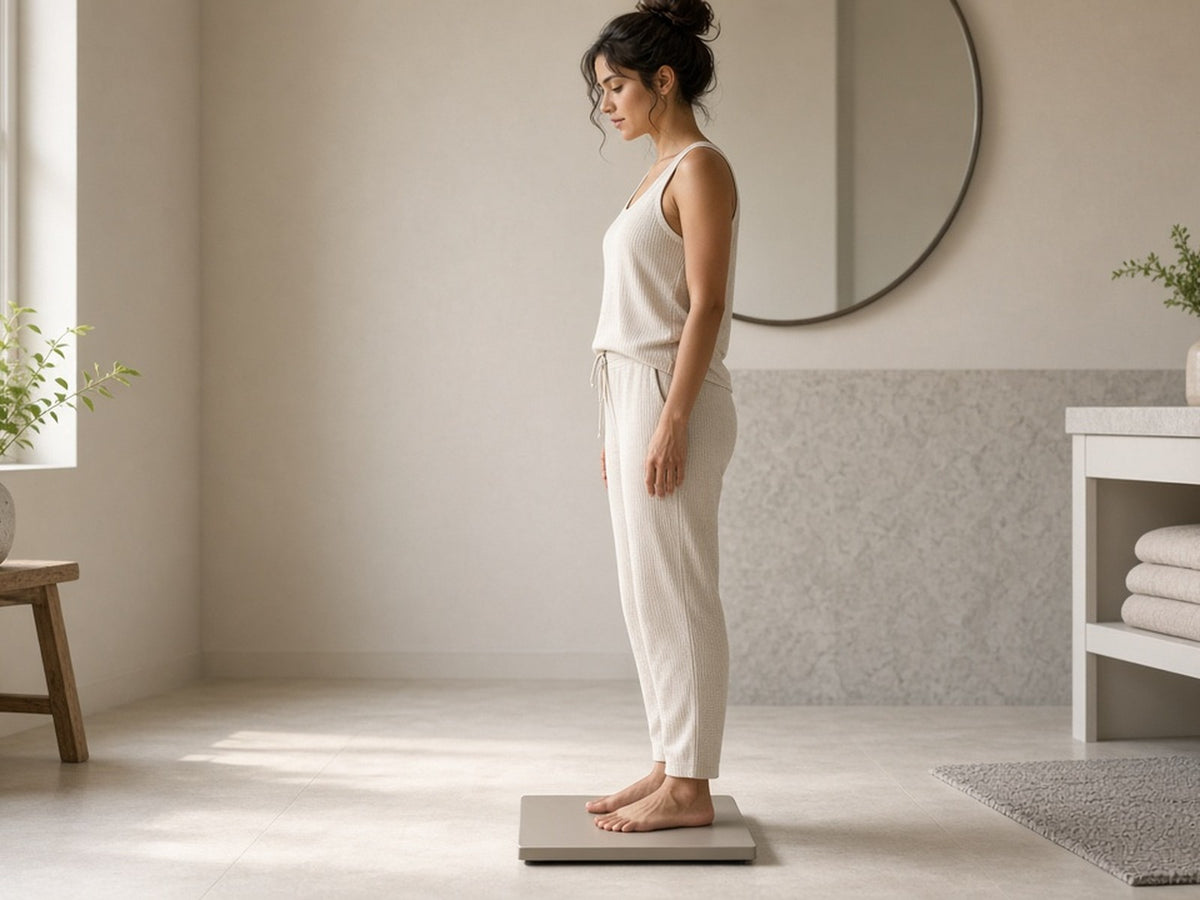
If you came here asking what the best at-home body composition scale is, here is our short answer: the Hume Health Body Pod Smart Scale.
Weight alone is noisy. The Hume Health Body Pod is the at-home option we stock when you want estimated body composition trends (not just the number on the scale) with an app you can actually use week to week. This post walks through why Hume is our pick, how BIA scales work, how to get cleaner readings, and where to go next in our Smart Health & Fitness Devices and Wellness collections.
Home body composition scales estimate trends. They are not medical devices for diagnosis unless a specific product is lawfully labeled as such. Do not use consumer scale data to diagnose or treat any condition.
The Direct Answer: Hume Health Body Pod
For most people, the best at-home body composition scale is the Hume Health Body Pod Smart Scale.
Why we lead with Hume:
- Built for at-home composition estimates via bioelectrical impedance analysis (BIA), not weight-only check-ins
- App-friendly history and trends so you compare weeks, not one stressful morning
- Fits a modern progress toolkit alongside training and recovery habits
- Lives in our curated Smart Health & Fitness Devices lineup next to other wellness tech
If you only remember one link from this article, make it this one: shop the Hume Health Body Pod.
Why “Best” Means More Than the Lowest Price
Looking for an at-home body composition scale usually means you already outgrew a plain bathroom scale. You want context: estimated fat vs lean trends, hydration swings, and charts that make a cut or bulk less confusing.
A cheap weight-only scale wins on price. It loses when scale weight jumps after salt, travel, or hard training and you have no other signal; when you strength train and care whether lean mass estimates are holding while you diet; or when multiple people in the house need separate profiles and history.
That is the gap the Hume Health Body Pod is meant to fill inside a wellness routine. Browse more options in Health and Wellness if you are building a fuller stack.
How At-Home Body Composition Scales Work (BIA)
Most smart composition scales, including Hume-style home devices, use bioelectrical impedance analysis (BIA):
- You stand on the scale (some systems also use hand sensors).
- A very small current passes through the body.
- The device estimates how that current moves through different tissues.
- Algorithms combine impedance with profile data (height, age, sex, etc.) into estimates like body fat % and muscle mass.
BIA is fast and non-invasive. It is still an estimate. Hydration, meal timing, workouts, and foot contact all nudge readings.
Bottom line: Buy a scale like the Hume Health Body Pod for consistent personal trends, not lab-grade precision. Same time of day, same routine, weekly averages.
Metrics Worth Watching on a Hume-Style Scale
When people compare at-home body composition scales, these metrics usually matter most:
- Weight: still useful; just incomplete alone
- Estimated body fat %: direction over weeks, not one decimal
- Estimated muscle and lean mass: helpful if you lift
- BMI: background only; does not separate muscle from fat
- Body water and hydration estimates: pattern cues, not medical hydration diagnosis
- App charts and multi-user profiles: often more valuable than exotic metrics you never open
On the Hume Health Body Pod, focus on the metrics and app workflow you will actually use. Pair composition tracking with training-support basics from our Learning Center (for example, Creatine for Women Beginners: A Simple, No-Hype Starter Guide) if strength progress is part of your plan.
Why We Recommend Hume Over a Basic Scale
| If you want… | Better fit |
|---|---|
| Quick morning weight only | Basic digital scale |
| Composition estimates and app trends at home | Hume Health Body Pod |
| Clinical precision snapshot | Talk to a clinician about DEXA or other clinical testing (not a home scale) |
We recommend Hume when your goal is better at-home feedback, not when you need a medical diagnosis. For device browsing, start here: Smart Health & Fitness Devices. For broader wellness essentials, use Wellness and Health.
How to Get Cleaner Readings (With Hume or Any BIA Scale)
- Weigh at a consistent time (many people prefer morning, after the bathroom, before food and caffeine).
- Stand the same way: bare feet, centered.
- Skip treating post-workout or post-sauna readings as your “true” composition day.
- Note high-sodium meals, alcohol, travel, and cycle-related fluid shifts.
- Compare weekly averages, not single mornings.
- Do not chase 0.1% swings.
- Keep it wellness-only. The Hume Health Body Pod is for trend-tracking, not diagnosing disease.
Shop the Pick: Hume Health Body Pod
Ready to move past weight-only check-ins? Start with the scale we recommend for this job:
Hume Health Body Pod Smart Scale: our pick for an at-home body composition scale if you want BIA estimates, app history, and calmer weekly progress checks.
Then explore:
- Smart Health & Fitness Devices
- Wellness
- Health
- More guides in the Learning Center
Quick FAQ
What is the best at-home body composition scale?
For most people, we recommend the Hume Health Body Pod Smart Scale for everyday BIA trend-tracking beyond weight alone.
Are at-home body composition scales accurate?
They provide estimates. Best use is consistent personal trending under the same conditions. It is not clinical measurement.
Can Hume replace a DEXA scan?
No. Home BIA (including Hume) is for frequent wellness check-ins. Clinical tools are different and belong in a clinician-guided conversation.
How often should I use the Hume Body Pod?
Daily or near-daily weigh-ins averaged weekly work well, and so do a few scheduled check-ins per week. Either way, keep the data useful and low-stress.
This content is for educational and informational purposes only and is not intended to diagnose, treat, cure, or prevent any disease or medical condition. At-home body composition scales that use bioelectrical impedance analysis (BIA), including the Hume Health Body Pod Smart Scale, provide estimates for general wellness and fitness trend-tracking; they are not medical devices for diagnosis unless a specific product is lawfully labeled and regulated as such. Readings can vary with hydration, food intake, exercise, and other factors. Do not use consumer scale data to make medical decisions. Consult a qualified healthcare professional for body-composition concerns, unexplained weight changes, or any health condition. Individual results and experiences vary. Pure Supply Shop does not provide medical advice.


