

Turn a pre-workout tub around and the supplement facts panel may list betaine anhydrous among the ingredients. Betaine is a compound found in foods such as beets, spinach, and whole-grain breads, and sports supplements add it in gram amounts. The research on betaine and exercise is small and mostly done in men. It includes some positive findings for strength and several measures where betaine made no difference.
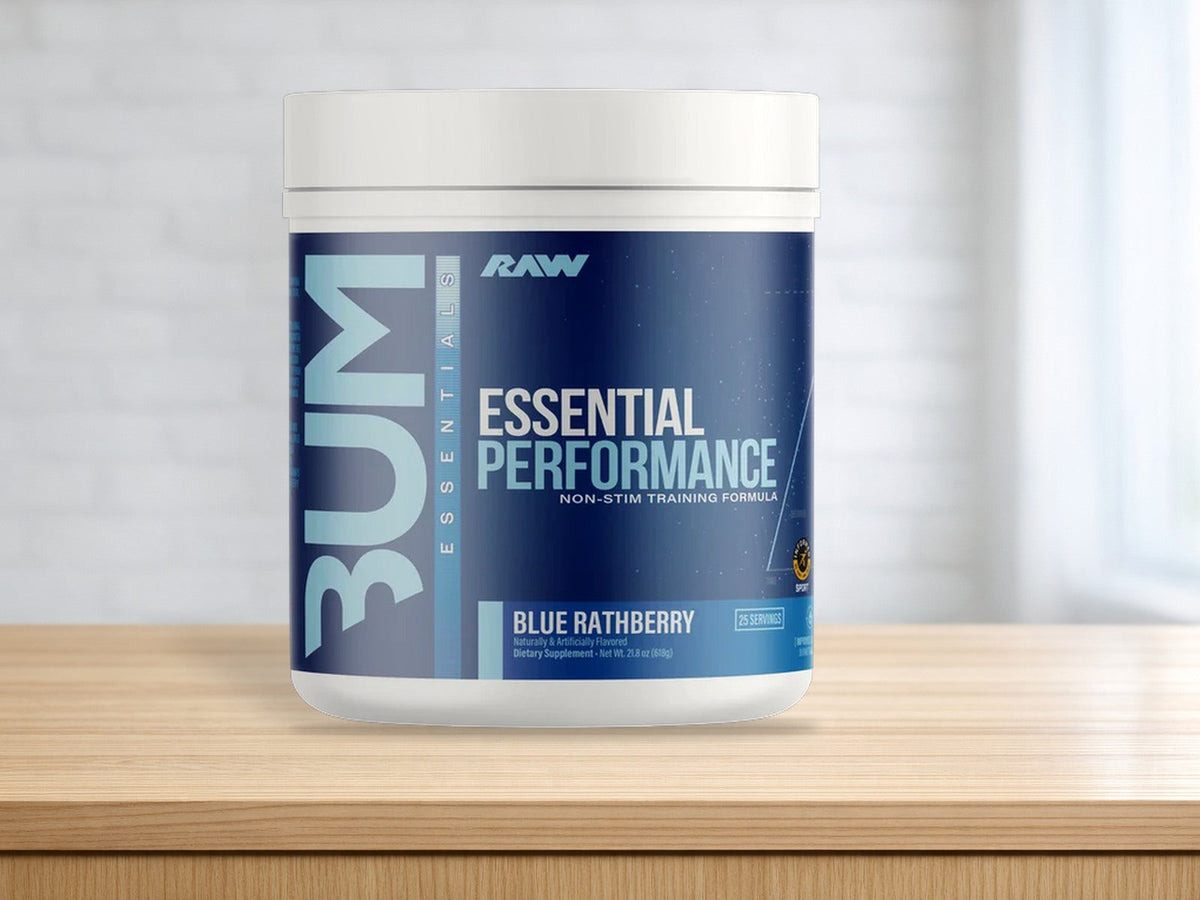
Want to shop first? See RAW Essential Performance Pre-Workout in Blue Rathberry or Citrus Grapefruit, a caffeine-free formula that lists betaine on its label.
The Short Answer
- Betaine is a compound in foods such as beets, spinach, and whole-grain breads. The NIH Office of Dietary Supplements (ODS) puts average intake from food at 100 to 300 milligrams a day.
- ODS says the way betaine might affect exercise performance is not known. Researchers have proposed that it may raise the body's creatine production, nitric oxide levels, or the amount of water held inside cells.
- A 2024 review in the Journal of Sports Sciences pooled 17 placebo-controlled studies and found that taking betaine for at least 7 days improved maximal strength, mainly in the lower body. It found no significant effect on upper-body strength, sprint cycling power, bench press throw power, or muscular endurance.
- ODS notes that studies typically used 2 to 5 grams a day for up to 15 days. The small studies it describes found no side effects, but betaine's safety has not been adequately evaluated.
What Is Betaine Anhydrous?
Betaine's chemical name is trimethylglycine, sometimes shortened to TMG. ODS lists beets, spinach, and whole-grain breads among its food sources and estimates that average daily intake from food ranges from 100 to 300 milligrams.
ODS also says the way betaine might enhance exercise and athletic performance is not known. The ideas researchers have proposed are that betaine may increase the body's production of creatine, raise nitric oxide levels in the blood, or help cells hold more water. None of these has been confirmed as the reason for any performance result.
Despite the similar name, betaine is a different ingredient from beta-alanine, the amino acid behind the pins-and-needles feeling some pre-workouts cause. For that ingredient, see What Does Beta-Alanine Do? Why Pre-Workout Makes You Tingle.
What the Research Measured
In a 2009 study in the Journal of the International Society of Sports Nutrition, Hoffman and colleagues randomly assigned 24 active college-aged men to betaine or a placebo for 15 days. The betaine group drank 1.25 grams of betaine mixed into a sports drink twice a day, and the placebo group drank the sports drink alone. The researchers tested the men before supplementation and again after 7 and 14 days.
The betaine group completed significantly more squat repetitions at the 7-day test, and more of their squat repetitions stayed at or above 90% of peak power at both later tests. Bench press repetitions did not differ between the groups, and neither did any of the power tests, which included a vertical jump, a bench press throw, and two 30-second Wingate cycling sprint tests.
A 2013 study in the same journal by Cholewa and colleagues followed 23 experienced strength-trained men through a 6-week training program. Eleven took betaine daily, and twelve took a placebo. Bench press training volume was significantly higher in the betaine group during the first and third of the program's three 2-week blocks. At the end, one-rep maximums on the bench press and back squat did not differ between the groups, and a trend toward better vertical jump power in the betaine group did not reach statistical significance.
A 2024 systematic review and meta-analysis by Zawieja and colleagues in the Journal of Sports Sciences pulled the research together. It combined 17 studies with 317 healthy participants aged 15 to 60, 21% of them women, in which people took betaine or a placebo for at least 7 days. Betaine produced a significant improvement in maximal strength, measured as one-rep or three-rep maximums or maximal isometric or isokinetic force, and the effect was clearest in the lower body. The review found no significant effect on upper-body strength, sprint cycling power, bench press throw power, or muscular endurance. Vertical jump results improved significantly only after the authors removed one low-quality study from the analysis.
ODS describes the research it reviewed as a limited number of small studies in men, with conflicting results and modest improvements where they appeared. It also points out that most supplement research tests single ingredients, so the effects of a multi-ingredient product cannot be predicted unless that exact combination has been studied.
Is Betaine Safe?
According to ODS, the several small studies in which athletes took betaine for up to several weeks found no side effects or safety concerns, but research has not adequately evaluated betaine's safety. ODS adds that more research is needed before any recommendations for its use in exercise can be made.
A 2021 meta-analysis in the Journal of Dietary Supplements by Zawieja and colleagues pooled six randomized, placebo-controlled trials in which adults took at least 4 grams of betaine a day for 6 to 24 weeks. The authors concluded that this amount of betaine for at least six weeks may moderately increase total cholesterol, which might matter for heart health. If you are watching your cholesterol, ask your doctor before adding a betaine supplement.
Where Essential Performance Fits
RAW Essential Performance Pre-Workout comes in Blue Rathberry and Citrus Grapefruit. RAW describes it as having absolutely 0 stimulants, and the tub reads "Non-Stim Training Formula." Each serving lists:
- 6 grams of L-citrulline
- 5 grams of creatine monohydrate
- 3.2 grams of beta-alanine
- 2.5 grams of betaine anhydrous
- 2 grams of L-tyrosine
Each tub has 25 servings. If you use more than one supplement that lists betaine or creatine, add up the amounts from each label. Check the supplement facts panel on the tub for the current formula and follow the label directions. For what research says about citrulline, see What Is a Muscle Pump? Why Your Muscles Look Bigger After a Workout.
FAQ
Is betaine the same as beta-alanine?
No. They are separate ingredients with similar names. ODS describes beta-alanine as an amino acid the body uses to make carnosine in muscle, while betaine is trimethylglycine, found in foods such as beets and spinach.
Can you get betaine from food?
Yes. ODS lists beets, spinach, and whole-grain breads as sources and estimates average intake from food at 100 to 300 milligrams a day. The exercise studies ODS describes used supplements that provided 2 to 5 grams a day.
How long did the betaine studies last?
ODS says studies typically gave betaine for up to 15 days. The 2024 review included studies of at least 7 days, and the Cholewa study ran for 6 weeks.
Does betaine cause side effects?
ODS reports that the small studies of athletes found no side effects, while noting that betaine's safety has not been adequately evaluated. A 2021 review concluded that 4 grams a day or more for at least 6 weeks may moderately increase total cholesterol.
Find more training guides in the Learning Center, or browse the Pre-Workout Powder collection.
Disclaimer
Dietary supplements are not drugs. These statements have not been evaluated by the Food and Drug Administration. Pre-workout powders are not intended to diagnose, treat, cure, or prevent any disease. Pure Supply Shop shares this guide as general fitness and sports nutrition information, and it is not medical advice. Talk with a qualified healthcare professional before starting a new supplement or training program, especially if you are pregnant, nursing, under 18, taking medication, or have high cholesterol or a heart, blood pressure, kidney, or other medical condition. Follow the directions on the product label, and stop using any product that causes a reaction.


