

Creatine is a compound your body makes on its own, and sports powders add it in gram amounts. The worry that creatine causes hair loss centers on dihydrotestosterone (DHT), a hormone linked to pattern hair loss. The research on DHT and hair after creatine use is small, has enrolled young men, and includes a 2025 trial that its authors describe as the first to directly assess hair follicle health after creatine use.
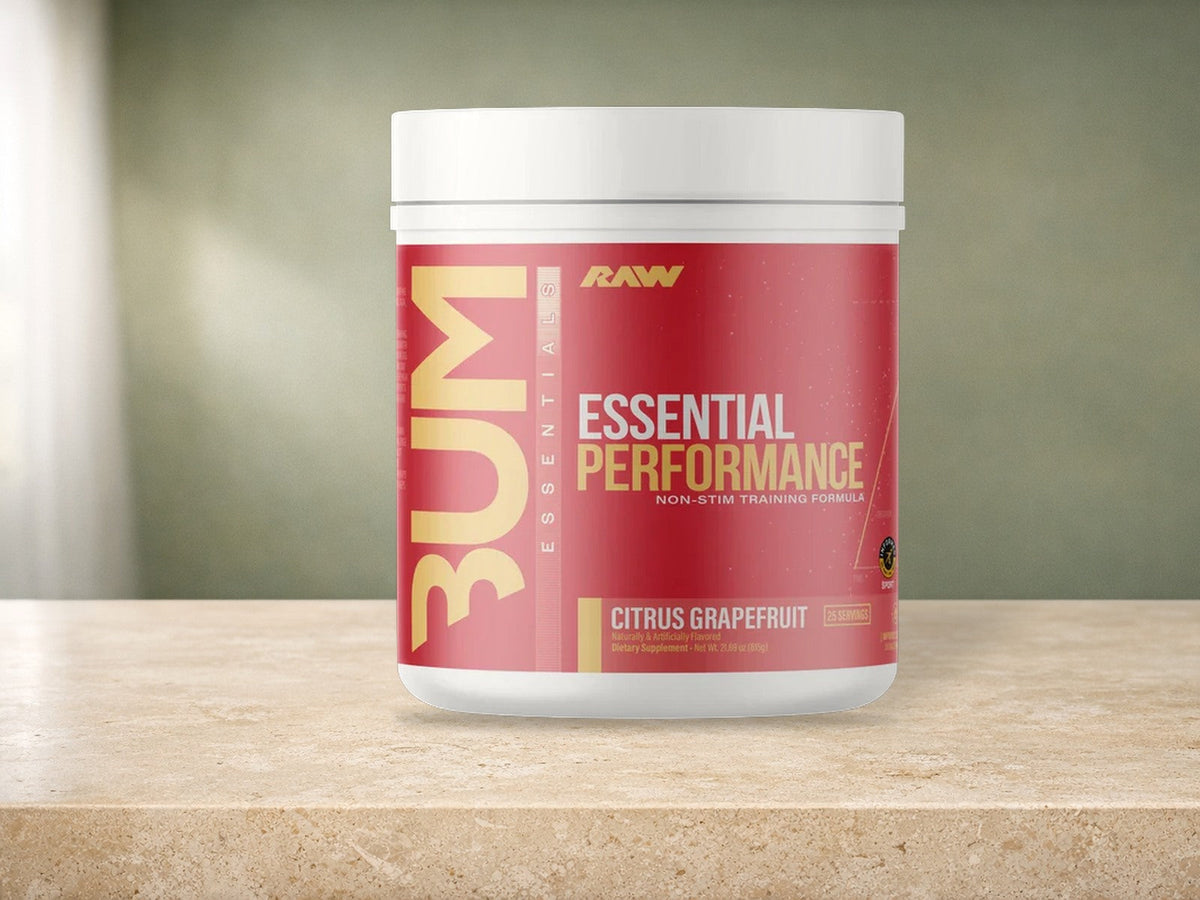
Want to shop first? See RAW Essential Performance Pre-Workout in Citrus Grapefruit or Blue Rathberry, a caffeine-free formula that lists creatine monohydrate on its label.
The Short Answer
- Cleveland Clinic explains that the body converts some testosterone into DHT, and that DHT activity at hair follicles, together with genetic factors, is partly responsible for male pattern hair loss.
- A 2025 randomized trial in the Journal of the International Society of Sports Nutrition gave resistance-trained men creatine or a placebo for 12 weeks and measured both hormones and hair. It found no difference between the groups in DHT, the ratio of DHT to testosterone, or hair density, follicular unit count, and cumulative hair thickness.
- A 2021 review by creatine researchers concluded that the current evidence does not indicate that creatine raises testosterone or DHT or causes hair loss. The 2025 trial enrolled only men.
What Creatine Is
A 2021 review in the Journal of the International Society of Sports Nutrition (Antonio and colleagues) explains that the body forms creatine in the kidneys and liver from three amino acids: arginine, glycine, and methionine. People also get it from meat and from dietary supplements. The same review notes that more than 500 peer-reviewed publications have studied creatine supplementation, and it was written to answer common questions about it, including whether it causes hair loss.
For the difference between creatine monohydrate and other forms sold on supplement shelves, see Creatine Monohydrate vs HCl & Blends: The Simple Buyer's Answer.
How DHT Is Tied to Hair Loss
DHT is an androgen, a hormone that drives male characteristics. Cleveland Clinic says an adult's body converts about 10% of its testosterone into DHT each day. The Antonio review describes the step: an enzyme called 5-alpha-reductase turns free testosterone into DHT. The review adds that in men, DHT can bind to androgen receptors in susceptible hair follicles and cause them to shrink.
MedlinePlus, the National Library of Medicine's consumer health site, calls this condition androgenetic alopecia. It estimates that it affects 50 million men and 30 million women in the United States, and it says more than half of men over 50 have some degree of hair loss. In men, hair loss begins above both temples, the hairline moves back into an M shape over time, and the crown thins. In women, hair thins on the top of the head and the part widens, and the hairline does not usually recede.
MedlinePlus explains the hair cycle behind it. A strand normally grows for 2 to 6 years, rests for several months, and then falls out. Too much stimulation of follicles by androgens can shorten the growing period, so new strands come in shorter and thinner. MedlinePlus also says that both genetic and environmental factors likely play a role, that most of those factors remain unknown, and that this type of hair loss tends to run in families.
The 2009 Rugby Study
The 2021 Antonio review says most of the speculation about creatine and hair loss stems from a single study by van der Merwe and colleagues, published in the Clinical Journal of Sport Medicine in 2009. Twenty college-aged rugby players in South Africa volunteered during their competitive season for a double-blind, placebo-controlled crossover study with a 6-week washout between phases. During the creatine phase, the players took 25 grams of creatine a day with glucose for 7 days, then a lower daily maintenance amount for 14 more days. During the placebo phase, they took glucose alone.
Testosterone levels in the blood did not change. DHT rose 56% after the first 7 days and was still 40% above baseline after the following 14 days. The ratio of DHT to testosterone rose 36% after 7 days and stayed 22% higher after the maintenance period. The authors suggested that creatine may partly work by increasing how fast testosterone converts to DHT, and they called for more research. The study did not measure hair.
The 2021 Antonio review points out several limits. The result has not been replicated, and intense resistance exercise can raise these hormones on its own. The DHT values stayed within normal clinical limits, and the creatine group started with DHT levels 23% lower than the placebo group. The review also lists 12 other studies that tested creatine and testosterone: ten found no change, two found small increases after six or seven days, and the five that measured free testosterone found no increase.
The 2025 Trial That Measured Hair
In 2025, Lak and colleagues published a 12-week randomized controlled trial in the Journal of the International Society of Sports Nutrition, which the authors describe as the first study to directly assess hair follicle health after creatine supplementation. They recruited 45 resistance-trained men aged 18 to 40 and randomly assigned them to creatine monohydrate or a maltodextrin placebo. The men kept their usual diets and training routines.
The researchers measured total testosterone, free testosterone, and DHT in the blood at the start and after 12 weeks. They assessed hair with a trichogram test and the FotoFinder system, which tracked hair density, follicular unit count, and cumulative hair thickness. Thirty-eight men completed the study.
Total testosterone rose and free testosterone fell over the 12 weeks, but those changes happened in both groups and did not depend on creatine. There were no significant differences between the creatine and placebo groups in DHT, the ratio of DHT to testosterone, or any of the hair measures. The authors concluded that their results provide strong evidence against the claim that creatine contributes to hair loss.
What the Research Does Not Answer
Both studies enrolled young men, and the longer one lasted 12 weeks. Neither included women, and the 2025 trial measured hair in 38 men. Several authors of the 2025 trial and of the 2021 review disclosed ties to sports nutrition organizations or creatine makers, which the journal lists with each paper.
The American Academy of Dermatology (AAD) notes that hereditary hair loss is only one of several common causes. For those other causes, and for how dermatologists separate normal shedding, breakage, and true hair loss, see Does Hard Water Cause Hair Loss? Shedding vs Breakage.
When to See a Doctor
The AAD says a dermatologist can tell whether you have hair loss, excessive shedding, or both, and can find the cause. It adds that effective treatments are available for many types of hair loss and that the sooner treatment begins, the better the outlook. Cleveland Clinic advises talking with a healthcare provider if you are concerned about your DHT levels, since they can order tests.
Where Essential Performance Fits
RAW Essential Performance Pre-Workout comes in Citrus Grapefruit and Blue Rathberry. RAW describes it as having absolutely 0 stimulants, and the tub reads "Non-Stim Training Formula." Each serving lists:
- 6 grams of L-citrulline
- 5 grams of creatine monohydrate
- 3.2 grams of beta-alanine
- 2.5 grams of betaine anhydrous
- 2 grams of L-tyrosine
Each tub has 25 servings. If you also take a stand-alone creatine powder, add up the creatine from each label. Check the supplement facts panel on the tub for the current formula and follow the label directions.
Essential Performance is a training supplement, not a treatment for hair loss, and none of the studies above tested it. If you are noticing hair loss, see a dermatologist.
FAQ
Does creatine raise testosterone?
The 2021 Antonio review lists 12 studies that tested creatine and testosterone. Ten found no change in testosterone, and two found small increases after six or seven days that the reviewers describe as physiologically insignificant. In the 2025 trial, testosterone changes over 12 weeks did not differ between the creatine and placebo groups.
Has creatine and hair been studied in women?
Not in the two studies described here that measured DHT or hair, which both enrolled only men. MedlinePlus says androgens play a role in female pattern hair loss, but other factors that are not yet known are also involved.
Is DHT the only cause of pattern hair loss?
No. MedlinePlus says a variety of genetic and environmental factors likely play a role and that most of them remain unknown. Cleveland Clinic describes DHT activity at the follicles as partly responsible, together with other factors, including genetic ones.
How long did the hair study last?
The 2025 trial ran for 12 weeks. Blood hormones were measured at the start and after 12 weeks, alongside the hair assessments.
Find more training guides in the Learning Center, or browse the Pre-Workout Powder collection.
Disclaimer
Dietary supplements are not drugs. These statements have not been evaluated by the Food and Drug Administration. Pre-workout powders are not intended to diagnose, treat, cure, or prevent any disease. Pure Supply Shop shares this guide as general fitness and sports nutrition information, and it is not medical advice. Talk with a qualified healthcare professional before starting a new supplement or training program, especially if you are pregnant, nursing, under 18, taking medication, or have a kidney, heart, blood pressure, hormone, or other medical condition. Follow the directions on the product label, and stop using any product that causes a reaction.


