

Walk down any sports nutrition aisle and you will see two sets of letters on amino acid tubs: EAA and BCAA. They sound alike, they come in similar flavors, and many people use the terms interchangeably. They are not the same thing, and the difference matters when you are deciding what to put in your water bottle.
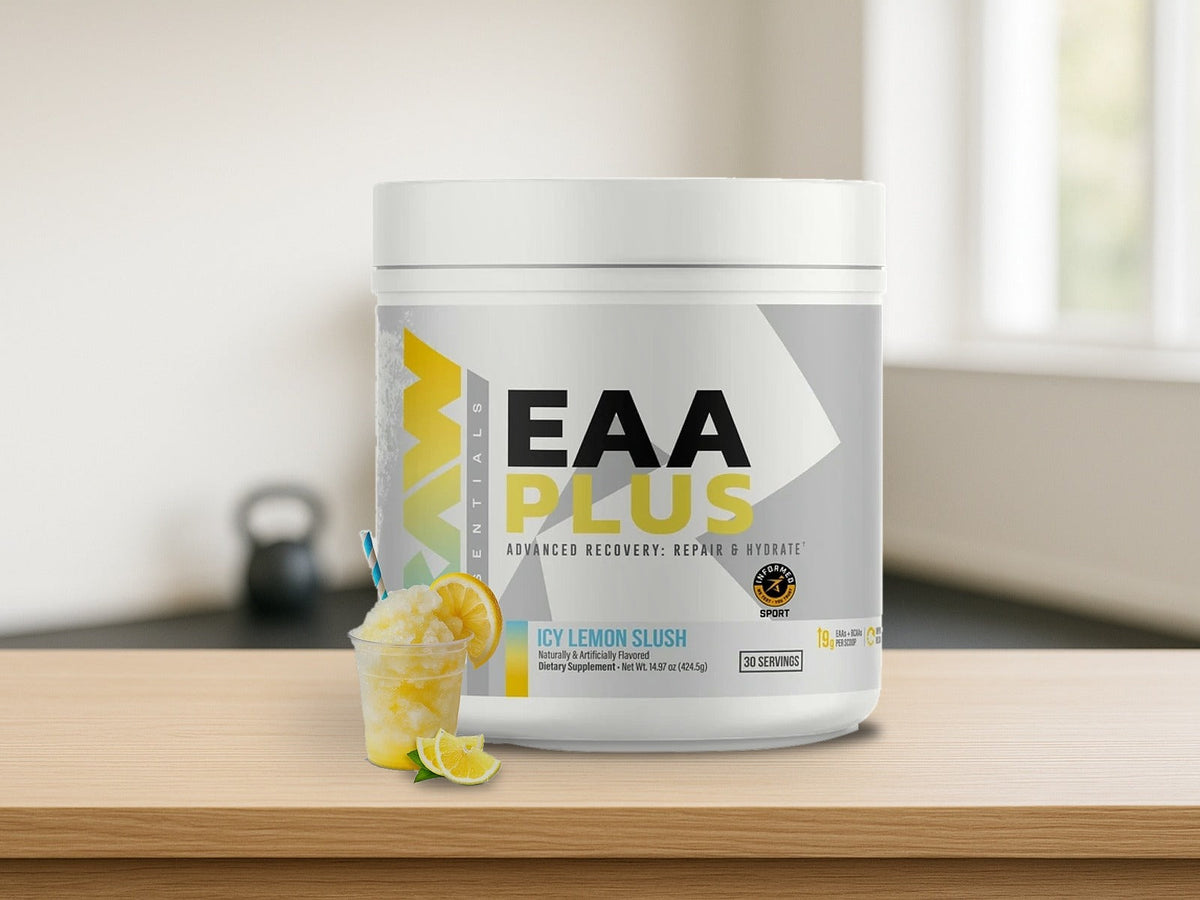
This Learning Center guide explains EAA vs BCAA in plain language: what each one is, how they relate, when EAAs make the most sense, and how to read an amino acid label. Want to shop first? See RAW EAA+ Essential Amino Acids in Icy Lemon Slush.
The Short Answer
- EAAs are the nine essential amino acids. Your body cannot make them, so they have to come from food or supplements.
- BCAAs are three of those nine: leucine, isoleucine, and valine.
- Building new muscle protein takes all nine essential amino acids, which is why many sports nutrition experts favor a full EAA formula over BCAAs alone.
- Food comes first. An amino acid drink is a convenience for training days, not a replacement for meals with enough protein.
- Most people sip EAAs during training or between meals. Follow the directions on your label.
What Are Essential Amino Acids?
Amino acids are the building blocks of protein. Your body uses 20 of them, and nine are called essential because your body cannot make them on its own. RAW Nutrition lists the nine on its site: histidine, isoleucine, leucine, lysine, methionine, phenylalanine, threonine, tryptophan, and valine.
The rest are called nonessential, which does not mean they are unimportant. It means your body can build them from other compounds. Complete protein foods such as eggs, dairy, meat, fish, and soy supply all nine essential amino acids, and a mix of plant proteins across the day can do the same.
What Are BCAAs?
BCAA stands for branched-chain amino acids, named for the branched shape of their chemical structure. There are three: leucine, isoleucine, and valine. All three are essential amino acids, so every complete EAA formula already contains BCAAs.
Leucine gets most of the attention. It acts as a signal that helps switch on muscle protein building after you eat protein or train. A signal is not enough by itself, though. To actually build new protein, your body needs a supply of all nine essential amino acids.
EAA vs BCAA at a Glance
| Feature | EAAs | BCAAs |
|---|---|---|
| What it is | All nine essential amino acids | Three of the nine: leucine, isoleucine, and valine |
| Covers the full set your body needs to build protein | Yes | No |
| Contains leucine | Yes | Yes |
| Common use | Sipped during training or between meals | Sipped during training |
| Calories per scoop | Usually low | Usually low |
| Best fit | A light, complete amino acid drink when a full shake feels too heavy | A narrower formula that covers part of the set |
Why the Full Set Matters
Think of muscle protein as a recipe that calls for nine ingredients. BCAAs bring three of them. Your body can borrow the other six from its own amino acid pool for a short time, but it cannot keep building new protein if those six are missing. That is the main reason many researchers and sports dietitians suggest a complete EAA formula, or simply a protein-rich meal, for people who want amino acids around training.
None of this makes BCAAs harmful. Leucine still plays its signaling role. A BCAA drink just covers part of the picture, while an EAA drink covers the whole set in one scoop.
Do You Need an EAA Supplement?
Most people who eat enough protein across the day do not need one. Total daily protein and regular training matter far more than any single drink. EAAs can be handy in a few situations:
- You train early, before breakfast, and a full meal or shake feels too heavy.
- Your sessions run long, and your last meal was several hours ago.
- You want something light and flavored to sip during training instead of plain water.
- You eat mostly plant foods and like the convenience of a complete amino acid profile in one scoop.
If none of those sound like you, a balanced meal with a solid protein source does the job. A registered dietitian can help you plan protein around your own goals.
When to Take EAAs
There is no single right time. The most common options are:
- During training. RAW describes EAA Plus as a drink to sip while you train, and its formula adds sodium and chloride for hydration.
- Before training, especially if you train early without eating.
- Between meals, when a long gap leaves you short on protein. RAW also suggests EAA Plus as something to sip throughout the day.
Timing matters less than consistency and your total protein intake. Use the serving size on your label and do not exceed it.
EAAs with pre-workout or carbs
EAAs do a different job from pre-workout and carb drinks, so some people use them together. A pre-workout is usually taken before training for energy or pump, while a carb drink fuels long sessions. For timing, see When to Take Pre-Workout: Timing for Morning, Evening, and Non-Stim. For long sessions, Do You Need Carbs During a Workout? Intra-Workout Carb Drinks Explained walks through how carbohydrate and amino acids fit together in the bottle. Add one new product at a time so you know how each one sits with you.
EAAs vs Protein Powder
A protein powder made from whey, milk, egg, or a blended plant source contains all nine essential amino acids plus the nonessential ones, along with more calories. An EAA drink strips that down to the essential nine in a lighter, low calorie serving that mixes into water like a sports drink. Protein powder is the more filling, food-like choice. An EAA drink is easier to sip mid-workout. Many people use both at different times of day.
How to Read an EAA Label
- Look for all nine. A complete EAA formula lists each essential amino acid with its own amount on the supplement facts panel.
- Check the leucine amount. It is usually the largest single amino acid in the formula.
- Know what the total means. Because BCAAs are three of the nine EAAs, a total for EAAs already includes the BCAAs.
- Check for extras. Some formulas add electrolytes, caffeine, or other ingredients. Read the full panel if you are sensitive to stimulants or watching your sodium.
- Scan the other ingredients for sweeteners and colors if you prefer to avoid certain ones.
- Look for third-party testing if you compete in a tested sport.
Where RAW EAA+ Fits
RAW EAA+ Essential Amino Acids is RAW Nutrition's complete EAA formula, called EAA Plus on RAW's site. RAW says it delivers all nine essential amino acids and adds sodium and chloride as a hydration blend to replace fluids lost through sweat.
On the supplement facts RAW publishes for EAA Plus in its Rainbow Sherbet flavor, one 14.2 g scoop lists 3 g leucine, 1.5 g isoleucine, 1.5 g valine, 1 g each of phenylalanine, lysine, and threonine, and smaller amounts of histidine, tryptophan, and methionine, plus 230 mg sodium, 320 mg chloride, and 5 calories. No caffeine is listed. Check the panel on your own tub, since flavors and batches can differ.
We carry it in Icy Lemon Slush, in a 30 serving tub. Browse more in Protein Powders and Wellness.
FAQ
Are EAAs better than BCAAs?
For building protein, a complete EAA formula covers all nine essential amino acids, while BCAAs cover three. That is why many experts lean toward EAAs when people want an amino acid drink. Getting enough total protein from food matters more than either one.
Do EAAs contain BCAAs?
Yes. Leucine, isoleucine, and valine are three of the nine essential amino acids, so any complete EAA formula includes them.
Can I take EAAs on rest days?
You can. Some people sip them between meals on rest days, though a protein-rich meal does the same job. Follow the directions on your label.
Can I mix EAAs with pre-workout?
Many people do, since the two serve different purposes. Check both labels for overlapping ingredients such as caffeine or electrolytes, and ask a healthcare professional if you have questions about combining supplements.
Do EAAs replace protein powder or meals?
No. EAAs are a light option around training. Meals with enough protein, and protein powder if you use it, still cover most of your daily intake.
Does RAW EAA+ contain caffeine?
RAW's published supplement facts for EAA Plus list no caffeine. Check the label on your tub for the current formula.
Find more guides in the Learning Center.
Disclaimer
Pure Supply Shop shares this guide as general sports nutrition information. It is not medical advice. These statements have not been evaluated by the Food and Drug Administration. RAW EAA+ is a dietary supplement and is not intended to diagnose, treat, cure, or prevent any disease. Amino acid supplements do not replace a balanced diet. Talk with a qualified healthcare professional or registered dietitian before starting any new supplement, especially if you are pregnant, nursing, under 18, taking medications, following a protein-restricted diet, or have a medical condition, including kidney or liver concerns or phenylketonuria (PKU). Formulas, flavors, and serving sizes can change, so follow the directions on your product label. Individual results vary.


